Overview
Project at a glance
Problem
Goals & Success Metrics
My Role
Key product decisions
Risks & edge cases I designed for
gizkidesigns@gmail.com
/in/Samuel Nwankwoala
X.com
gizkidesigns
Gizkidesigns
© 2026 All rights reserved.
Streamlining transactions in Pan-African Countries through PAPSS
Company:
Afripay
A therapist finishes with a client. Seven minutes before the next one. In that window, they need to tighten notes, add clinical justification, maybe restructure into SOAP format. Five clients a day, five sets of notes, five windows that never feel long enough. Muse started with that friction. Not the writing, but the overhead of asking for help.

Overview
AfriPay is a mobile app concept that helps individuals and businesses send and receive cross-border payments between Nigeria, Ghana, Kenya, and Zimbabwe using PAPSS for faster local-currency settlement. Africa’s cross-border payments are still affected by fragmented infrastructure, multiple currency conversions, and high costs. PAPSS was created to enable local-currency clearing and settlement across African countries, but the “last mile” challenge remains turning the infrastructure into a consistent retail user experience.

Project at a glance
Role: Product Designer
Platform: Mobile App (iOS/Android)
Users: Individuals, SMEs, merchants, freelancers
Markets: Nigeria, Ghana, Kenya, Zimbabwe
Deliverables: User flows, wireframes, UI, prototype, UX copy, key states (success/fail/pending), usability feedback summary
Team: 2 Designers, 1 Product Manager, 2 Mobile Engineers (iOS & Android), 4 Backend Engineers, 2 DevOps Engineers, 1 QA Engineer, 2 Infosec Engineers
Timeline: 3 Weeks 4 days (17/11/2025 - 12/12/2025)
Tools: Figma, FigJam, Miro, Azure Boards
Problem
People and SMEs who trade across borders need a way to pay and get paid without hidden fees, unclear FX rates, and long settlement times. In many corridors, sending money can still be costly, and users often feel unsure whether a payment will go through or when it will arrive.
User pains we saw
High fees and avoidable FX costs due to multiple intermediaries
Slow settlement (often days) and uncertainty after sending
Limited interoperability across local payment rails and messaging standards (ISO 20022 vs ISO 8583 vs proprietary systems)
Access gaps for SMEs and merchants who need simple, affordable cross-border payments

Goals & Success Metrics
User goals
Know the full cost before confirming (fees + FX + total)
Send money in a few steps, and track status clearly
Save recipients and repeat payments easily (especially for businesses)
Track progress without contacting support.
Operational / product targets (from the framework)
Transaction success rate: > 98%
Average settlement time (PAPSS): < 60 seconds
Average settlement time (fallback rails): < 24 hours
Platform uptime: 99.5% +
My Role
I'm the lead product designer for this project. I collaborated with Kabiru (Product Designer) and Bolu (Product Manager) throughout this project.
Responsibilities
As the Lead Product Designer, I focused on making PAPSS feel usable at the customer level by designing:
A consistent multi-country onboarding + wallet experience
A simple send flow (individual and business)
Clear pricing, FX, and status updates
Failure recovery (retry, edit details, support handoff)
UI patterns that scale across four markets
Key product decisions
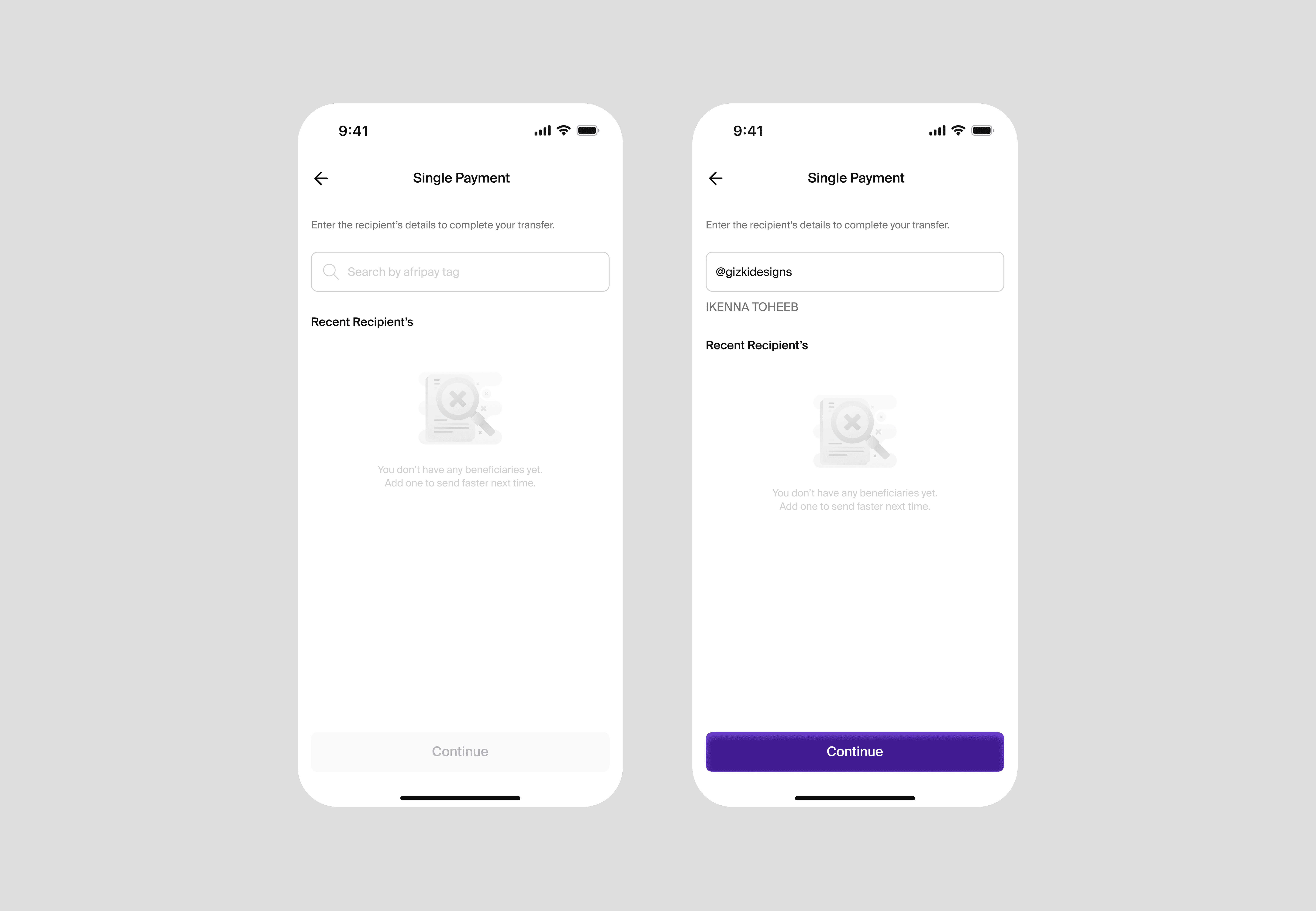
AfriPayTag for simple cross-border transfers: Instead of long account details, users can send to a memorable AfriPayTag that resolves the recipient’s details (name, country, linked wallet/account, currency).
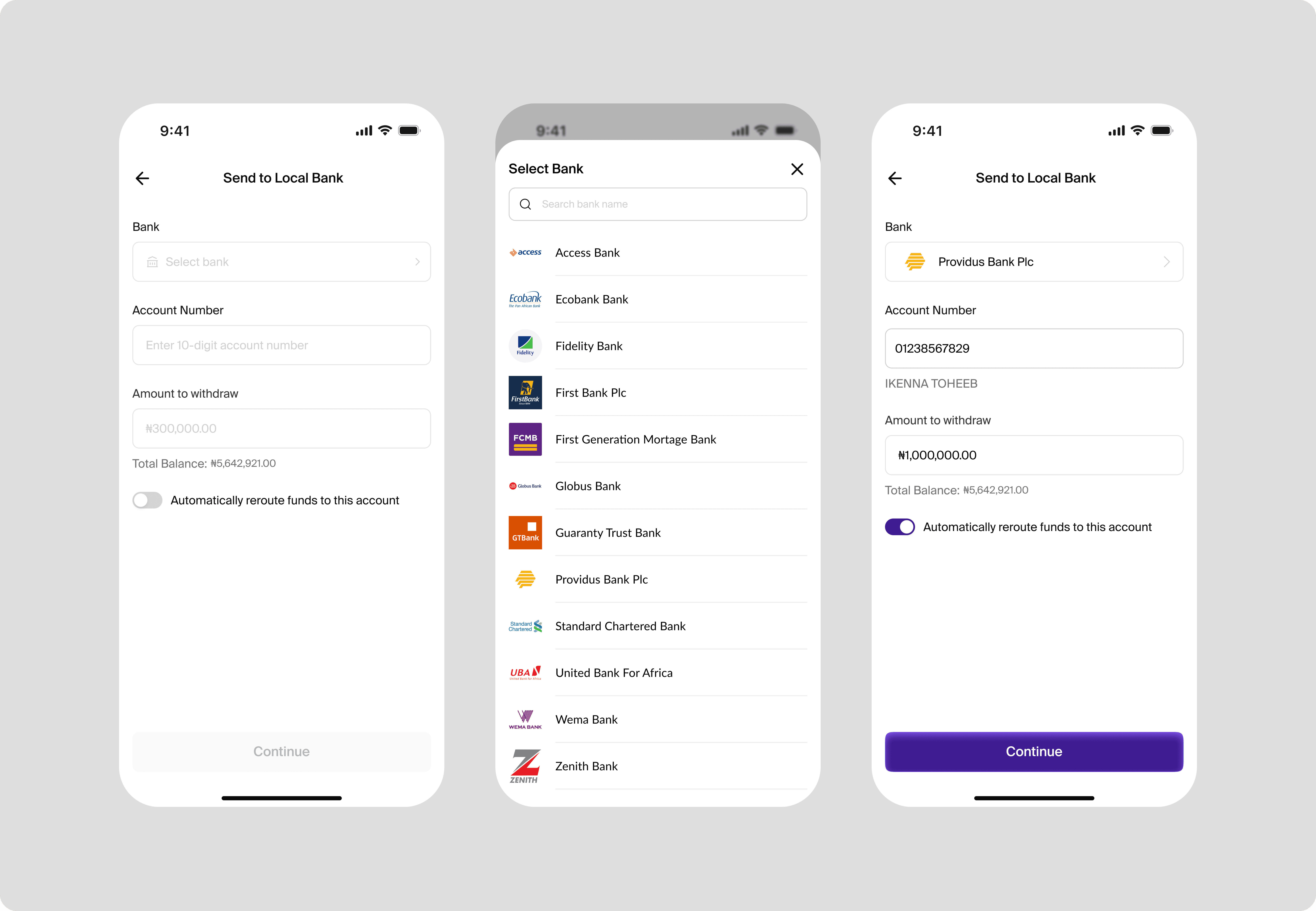
Multi-currency wallets + local payouts: AfriPay supports wallets across NGN, GHS, KES, and ZWL, with local withdrawals routed through domestic rails (e.g., NIP, GhIPSS, PesaLink/RTGS, ZIPSS).
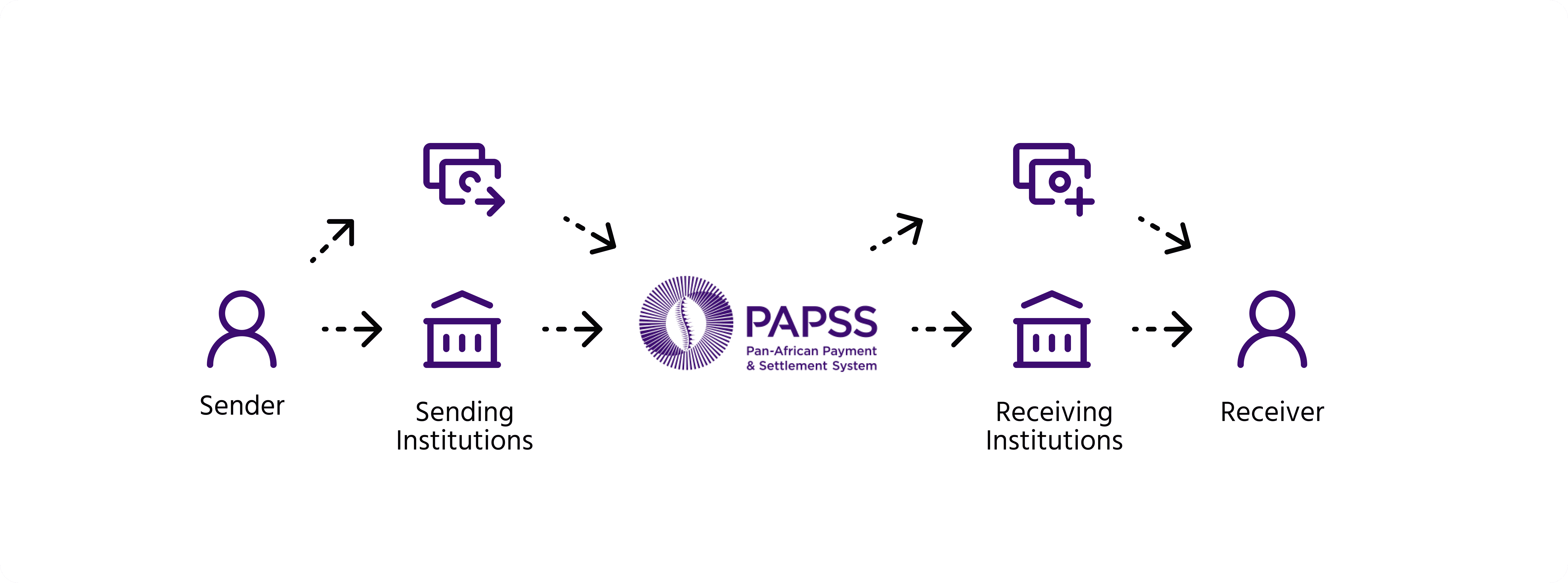
Intelligent routing (PAPSS first, fallback when needed): The routing engine selects the best available rail per corridor (PAPSS where available; alternate rails where needed) to balance speed, cost, and reliability.
Built for individuals and businesses: AfriPay supports single transfers and bulk payments, so businesses can pay multiple recipients across different countries in one flow.

CORE FLOWS
Onboarding (individual + business)
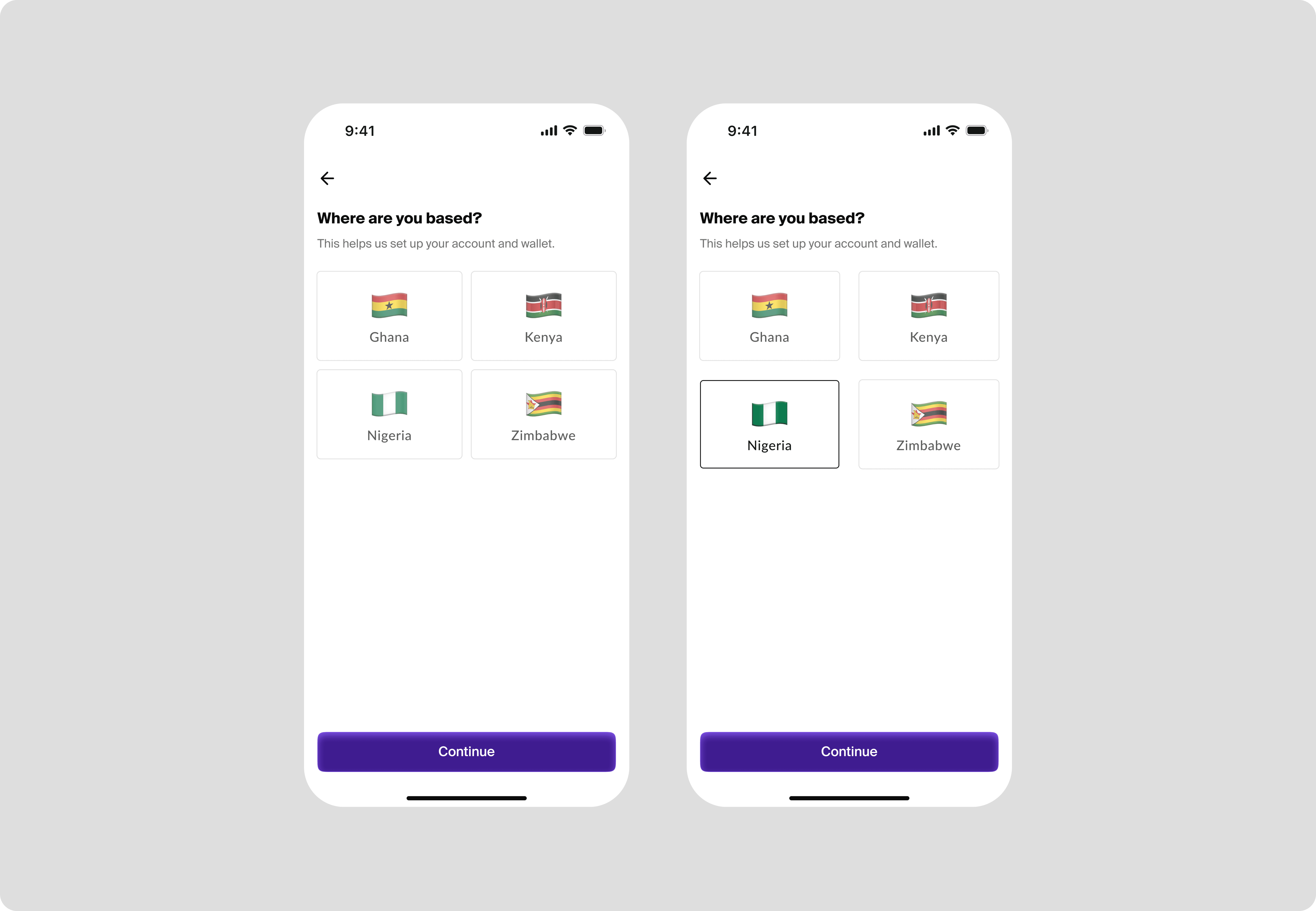
Country selection (Nigeria / Ghana / Kenya / Zimbabwe)
Account type: Individual or Business
KYC/KYB capture with local requirements (examples referenced: BVN in Nigeria, Ghana Card in Ghana, ID/passport in Kenya)
Create AfriPayTag + secure sign-in
Send money (single transfer)
Enter recipient AfriPayTag + amount
System validates identity/risk, checks balance/limits
User reviews fees + FX + total
Confirm → status updates (pending/processing/completed/failed)
Bulk payments (business)
Upload or add recipients (AfriPayTag + amount)
Review totals + corridor summary
Confirm and track each payment status


Risks & edge cases I designed for
Tag collisions/spoofing: strict rules + availability checks
FX volatility: short FX rate locks (60–90 seconds) for confirmation screens
PAPSS downtime: fallback rails + clear “what happens next” messaging
Disputes/refunds: ledger-first reversals coordinated with settlement adjustments
Outcome
Modeled reduction in transaction costs by 50–70% and settlement time from days to seconds when routed through PAPSS
Defined success KPIs (success rate, settlement time, uptime) to guide pilot and iteration
Learnings & next steps
Learnings
For cross-border payments, users trust the product when fees + FX + status are clear and consistent across markets.
For businesses, confidence comes from repeatability (saved recipients) and proof (receipts + reference IDs).
A “simple send” experience still needs strong back-end logic (routing, compliance, reconciliation) to feel reliable.
Next steps
Expand to additional PAPSS-connected markets and corridors (phased rollout approach)
Add business features: scheduled payouts, invoices/payment links, reconciliation exports
Explore future integrations mentioned in the framework (e.g., trade finance automation, CBDC/stablecoin research as PAPSS evolves)
Streamlining transactions in Pan-African Countries through PAPSS
Company:
Afripay
A therapist finishes with a client. Seven minutes before the next one. In that window, they need to tighten notes, add clinical justification, maybe restructure into SOAP format. Five clients a day, five sets of notes, five windows that never feel long enough. Muse started with that friction. Not the writing, but the overhead of asking for help.
Overview
AfriPay is a mobile app concept that helps individuals and businesses send and receive cross-border payments between Nigeria, Ghana, Kenya, and Zimbabwe using PAPSS for faster local-currency settlement. Africa’s cross-border payments are still affected by fragmented infrastructure, multiple currency conversions, and high costs. PAPSS was created to enable local-currency clearing and settlement across African countries, but the “last mile” challenge remains turning the infrastructure into a consistent retail user experience.
Project at a glance
Role: Product Designer
Platform: Mobile App (iOS/Android)
Users: Individuals, SMEs, merchants, freelancers
Markets: Nigeria, Ghana, Kenya, Zimbabwe
Deliverables: User flows, wireframes, UI, prototype, UX copy, key states (success/fail/pending), usability feedback summary
Team: 2 Designers, 1 Product Manager, 2 Mobile Engineers (iOS & Android), 4 Backend Engineers, 2 DevOps Engineers, 1 QA Engineer, 2 Infosec Engineers
Timeline: 3 Weeks 4 days (17/11/2025 - 12/12/2025)
Tools: Figma, FigJam, Miro, Azure Boards
Problem
People and SMEs who trade across borders need a way to pay and get paid without hidden fees, unclear FX rates, and long settlement times. In many corridors, sending money can still be costly, and users often feel unsure whether a payment will go through or when it will arrive.
User pains we saw
High fees and avoidable FX costs due to multiple intermediaries
Slow settlement (often days) and uncertainty after sending
Limited interoperability across local payment rails and messaging standards (ISO 20022 vs ISO 8583 vs proprietary systems)
Access gaps for SMEs and merchants who need simple, affordable cross-border payments
Goals & Success Metrics
User goals
Know the full cost before confirming (fees + FX + total)
Send money in a few steps, and track status clearly
Save recipients and repeat payments easily (especially for businesses)
Track progress without contacting support.
Operational / product targets (from the framework)
Transaction success rate: > 98%
Average settlement time (PAPSS): < 60 seconds
Average settlement time (fallback rails): < 24 hours
Platform uptime: 99.5% +
My Role
I'm the lead product designer for this project. I collaborated with Kabiru (Product Designer) and Bolu (Product Manager) throughout this project.
Responsibilities
As the Lead Product Designer, I focused on making PAPSS feel usable at the customer level by designing:
A consistent multi-country onboarding + wallet experience
A simple send flow (individual and business)
Clear pricing, FX, and status updates
Failure recovery (retry, edit details, support handoff)
UI patterns that scale across four markets
Key product decisions
AfriPayTag for simple cross-border transfers: Instead of long account details, users can send to a memorable AfriPayTag that resolves the recipient’s details (name, country, linked wallet/account, currency).
Multi-currency wallets + local payouts: AfriPay supports wallets across NGN, GHS, KES, and ZWL, with local withdrawals routed through domestic rails (e.g., NIP, GhIPSS, PesaLink/RTGS, ZIPSS).
Intelligent routing (PAPSS first, fallback when needed): The routing engine selects the best available rail per corridor (PAPSS where available; alternate rails where needed) to balance speed, cost, and reliability.
Built for individuals and businesses: AfriPay supports single transfers and bulk payments, so businesses can pay multiple recipients across different countries in one flow.
CORE FLOWS
Onboarding (individual + business)
Country selection (Nigeria / Ghana / Kenya / Zimbabwe)
Account type: Individual or Business
KYC/KYB capture with local requirements (examples referenced: BVN in Nigeria, Ghana Card in Ghana, ID/passport in Kenya)
Create AfriPayTag + secure sign-in
Send money (single transfer)
Enter recipient AfriPayTag + amount
System validates identity/risk, checks balance/limits
User reviews fees + FX + total
Confirm → status updates (pending/processing/completed/failed)
Bulk payments (business)
Upload or add recipients (AfriPayTag + amount)
Review totals + corridor summary
Confirm and track each payment status
Risks & edge cases I designed for
Tag collisions/spoofing: strict rules + availability checks
FX volatility: short FX rate locks (60–90 seconds) for confirmation screens
PAPSS downtime: fallback rails + clear “what happens next” messaging
Disputes/refunds: ledger-first reversals coordinated with settlement adjustments
Outcome
Modeled reduction in transaction costs by 50–70% and settlement time from days to seconds when routed through PAPSS
Defined success KPIs (success rate, settlement time, uptime) to guide pilot and iteration
Learnings & next steps
Learnings
For cross-border payments, users trust the product when fees + FX + status are clear and consistent across markets.
For businesses, confidence comes from repeatability (saved recipients) and proof (receipts + reference IDs).
A “simple send” experience still needs strong back-end logic (routing, compliance, reconciliation) to feel reliable.
Next steps
Expand to additional PAPSS-connected markets and corridors (phased rollout approach)
Add business features: scheduled payouts, invoices/payment links, reconciliation exports
Explore future integrations mentioned in the framework (e.g., trade finance automation, CBDC/stablecoin research as PAPSS evolves)